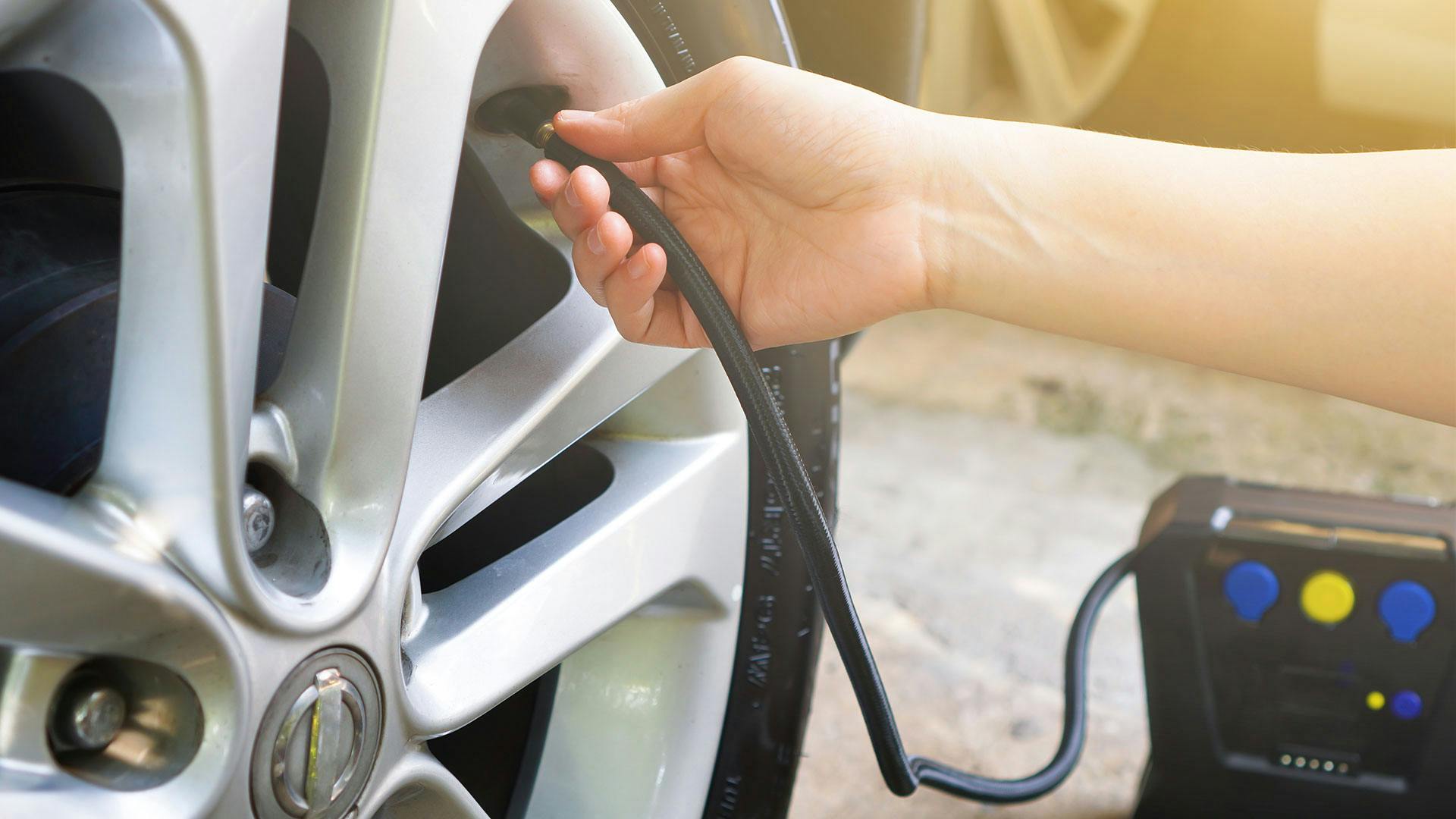
If you currently own an electrified vehicle, I don’t have to sit here and bore you to tears with all its benefits. But one of the main reasons why you purchased an electrified vehicle is to save money on gas, which means maximizing your driving range. One way to ensure you’re getting every mile possible is to drive on properly inflated tires. We’ll provide more information below on why driving on underinflated or overinflated tires can affect your range, but first let’s explain why you should invest into a portable tire inflator or air compressor.
Many years ago, the only reliable way to put air in your tires was to visit your local gas station. Most car owners kept a tire pressure gauge in their glovebox to regularly check their tire pressure. Yes, there was a time cars didn’t have tire pressure monitoring systems (TPMS), so you didn’t even know if you were driving on underinflated tires. Now, and especially on electrified vehicles, we have warnings and lights for everything imaginable. So you might be wondering, do I really need a portable air inflator?
For starters, your TPMS functions off a threshold and will only alert you once it has reached that threshold. Generally, that’s 25 percent below the manufacturer’s recommended tire pressure. If you’re waiting until that light illuminates, you’ve already sacrificed too much range. Having a portable tire inflator or air compressor handy means you can regularly check your tires’ pressure and give it the air they need to maximize your driving range.
Below, you’ll find our recommendations for the best portable tire inflators or air compressors you can currently buy. After that, you’ll find more information on the importance of proper tire pressure and how to choose the right portable tire inflator for you and your vehicle.
1. Top pick: NOCO AIR10

For a mix of affordability, capability, and dependability, my go-to portable tire inflator is the NOCO AIR10. NOCO offers more robust models in the AIR15 and AIR20, but those come at a higher price. If you are dealing with larger tires or want quicker fill times, it is worth looking at those higher-end options too.
What really sets the NOCO AIR10 apart for me is how well put together it is. The build feels solid, it is the quietest inflator I have used so far, and the built-in storage for the hose and accessories is genuinely thoughtful. I have had positive experiences with NOCO’s products in the past, especially their portable jump starters, so that track record adds to my confidence. The AIR10 is simple to operate, but it is not a cordless unit, and I have a separate recommendation for that. You will need to run it off your car’s 12V outlet, which means managing a cable as you move around the vehicle.
If you are fine with that tradeoff, my only real concern is how the soft-touch buttons on top will hold up over years of use. It is also a bit bulkier and heavier than some of the more compact inflators out there, but in my view, that is the trade you make for a pump that is this capable and reliable.
2. Best cordless option: GooLoo GT160

If you prefer the freedom of a cordless tire inflator, my recommendation is the GooLoo GT160. There is a more powerful Dual version in the lineup that I plan to test in the future, but it costs more and is probably unnecessary for most people. The GT160, on the other hand, is a more budget-friendly option that I reviewed last month, and for the typical car owner, I think it hits the sweet spot—as long as you remember to keep it charged.
Because it is cordless, the GooLoo GT160 runs off its built-in 7500mAh battery. In my testing, I had no trouble topping off all four tires on a single charge, although recharging the unit itself does take a bit of time. The good news is that I have not noticed any meaningful battery drain while it sits unused in my glovebox, though I still make a habit of checking it about once a month.
The biggest advantage here is convenience, since you do not have to fuss with a cable from your car’s interior or attach clamps to your battery. My only real gripe is the length of the inflator hose. In one instance, the valve stem was at the 12 o’clock position, and the hose was just short enough that I could not rest the inflator on the ground while using it. Aside from that, I do not have any major complaints.
3. Best for trucks/SUVs: GSPSCN heavy duty tire inflator
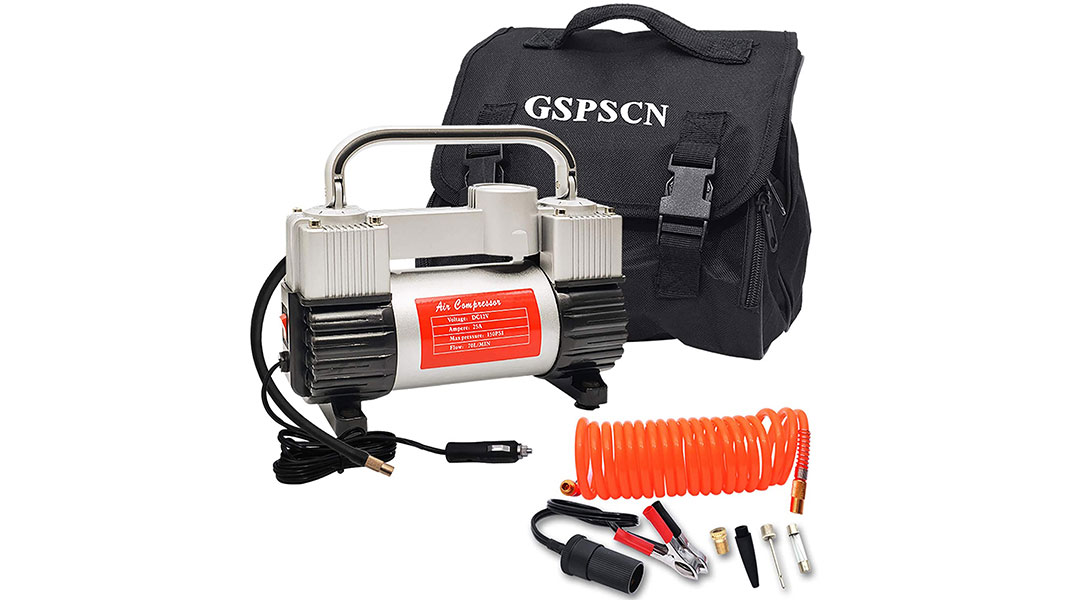
Now if you own an electrified light or full-size pickup truck, you’ll want a more heavy duty tire inflator. For that, we recommend this unit from GSPSCN, which features a double cylinder design to inflate tires to a maximum pressure of 150 psi. It works quickly too, with the company claiming it’ll inflate an 18-inch tire from zero-to-40 psi in just 1.5 minutes. It’s designed to be used on SUVs, trucks, vans, and larger vehicles, but it can also accommodate traditional sedans and smaller cars.
For power, you can use your cigarette lighter receptacle, or clamp it directly to your car’s battery. This option does not have a built-in auto shut-off feature, so you’ll have to monitor the pressure yourself. It’s available in three different color options: silver, titanium, and red.
4. Multipurpose option: BLACK+DECKER cordless inflator
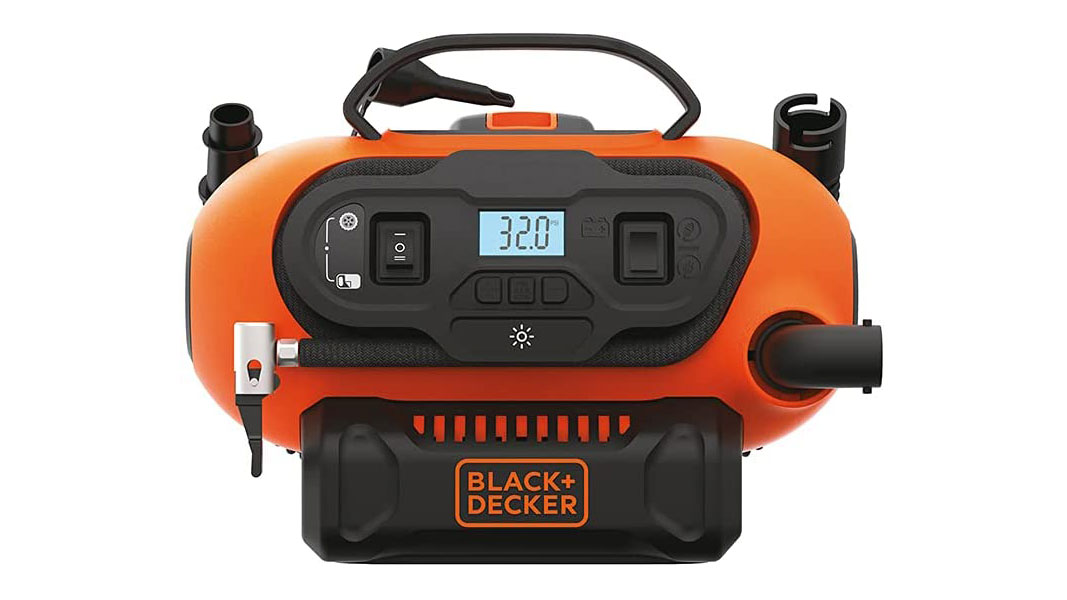
Are you one of those shoppers who prefer buying a product from a brand you recognize? We don’t blame you, especially with how many questionable products there are these days being sold online. So if you want a dependable brand you’ve heard of over the years, check out BLACK+DECKER’s multipurpose cordless inflator. For years, BLACK+DECKER has produced an assortment of tools and other household accessories, and if you already own a few of the brand’s 20V MAX tools, you can take advantage of your batteries for cordless operation.
This portable inflator can be powered by either 12-volt DC, 120-volt AC, or the previously mentioned 20V MAX battery. That means you can use it around the house through a standard electrical outlet, plug it into your car’s cigarette lighter receptacle to inflate your tires, or take it with you camping to inflate an air mattress with the 20V MAX battery.
As you can expect from a BLACK+DECKER product, this air compressor is equipped with an automatic shut-off, once it reaches the designated pressure.
5. Also consider: AstroAI portable air compressor
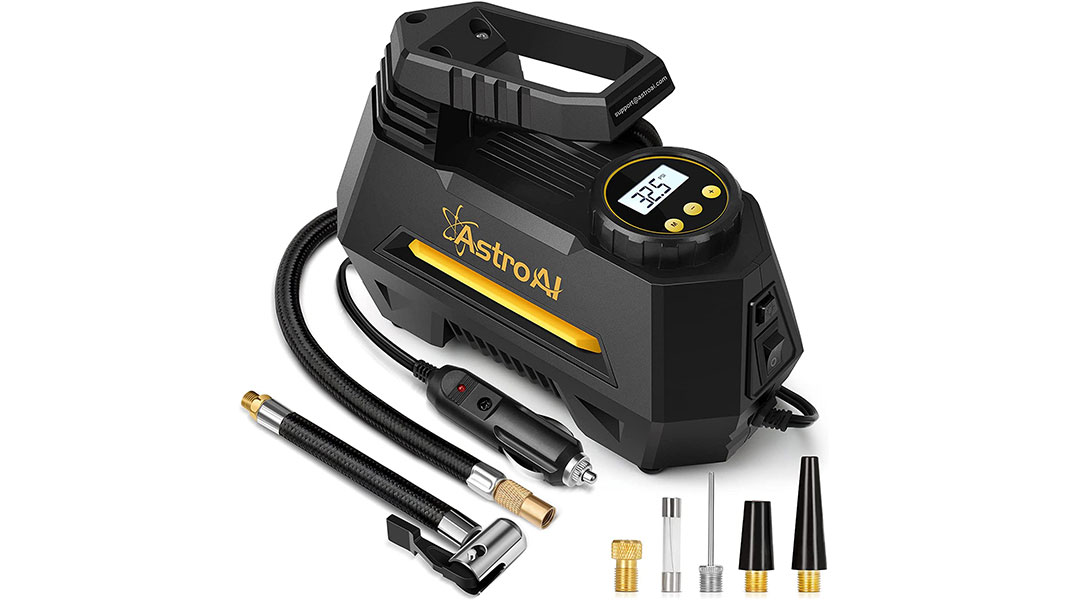
Our final recommendation is pretty similar to our top pick in both style and function. It comes from AstroAI and you can choose from four different highlight colors: blue, orange, red, and yellow. Like the EPAuto unit, it has programmable inflation, so you set your desired pressure and let the compressor do all the work. The digital display at the top of the unit is also similar, with a backlit LCD screen and the capability to display in four different units. An emergency LED light can also be found.
When it comes to choosing between the AstroAI and EPAuto recommendation, it may come down to personal preference. I personally have experienced good customer service from EPAuto, for what it’s worth, but AstroAI doesn’t seem to have very many complaints. I’d go so far as to say for the average car owner, you likely won’t notice a difference in performance between the two units, so go with the one you prefer.
What to look for when purchasing a portable tire inflator
If you’ve browsed around any online retail outlet for a portable tire inflator, you’ve probably noticed just how many different brands and options there are to choose from. As you can imagine, most of these come from overseas and it’s likely there are just a handful of factories producing all the different brands out there. So how do you choose just one when many of them have similar features and price points?
Most portable tire inflators are available for under $50, which makes them pretty affordable. If you don’t drive that often, you can likely get away with purchasing a cheaper unit to save a few bucks. But honestly, I recommend getting one of the recommendations on the list, as the cheaper pumps do often fail. I also recommend purchasing a unit with an auto shut-off feature, so long as it’s capable of inflating your tires. If you care about how long it takes to inflate your tires — at a track event, for example — you’ll want an inflator that is more powerful and works quickly. Otherwise, speed shouldn’t be a primary concern for you and some of the slower pumps are adequate.
Then there’s the matter of convenience. If you prefer a cordless option, that narrows down your choices significantly. But then you’ll have to worry about keeping a battery charged at all times. I personally prefer a corded tire inflator that uses your car’s cigarette lighter receptacle for power. It’s mildly inconvenient in that you’ll have to move the inflator from your driver side to your passenger side when inflating your tires, but it’s very minor compared to having to keep a battery charged at all times. This way, you can just leave the inflator in your trunk or frunk and it’ll always be available to you when you need it.
Lastly, check user reviews and see how the company handles complaints and issues with its products. Look for a company with prompt replies and good customer support. Even the most reliable brands will likely have a few duds, and you might just be one of the unlucky few to get a faulty unit.
How to use a portable tire inflator
If you opted to purchase a portable tire inflator with an auto shut-off feature, then they’re pretty simple to use. You’ll want to unscrew the valve stem cap, screw in the tire inflator, set your desired tire pressure, and turn the unit on. Browse around on EV Pulse from your phone while waiting for the pump to do its job. If your tire inflator doesn’t have an auto shut-off feature, you’ll need to keep an eye on the tire pressure gauge to stop the unit once your tires are properly inflated.
Portable tire inflators are one of the easiest tools to use and luckily, manufacturers have made them even simpler thanks to auto shut-off. Just keep a close eye to make sure the unit inflates your tires to your desired pressure!
The most important thing to remember is to inflate your tires while they are cold. As tires warm up, the pressure typically increases 3 to 4 psi, so if you want to be accurate and follow recommended guidelines, inflate your tires after they’ve been sitting for a few hours or even overnight.
Why do I need a portable tire inflator?
Driving on underinflated or overinflated tires can have a negative impact on your EV’s range. As we mentioned before, your TPMS isn’t designed to warn you until it passes a certain threshold, typically 25 percent. Tires naturally will lose air, especially in different weather conditions, and just a few psi can affect your driving range. Low tire pressure also reduces the life of your tire, and the tires on your EV likely aren’t cheap.
We recommend all car owners to have a portable tire inflator in their garage, trunk, or frunk. Routine checks can save you time, money, and possible headache, not to mention knowing that you’re getting the range you expect from your EV. The convenience of being able to inflate your tires wherever you want is worth the price of admission.
What is the recommended tire pressure for my car?
The easiest way to find the recommended tire pressure for your car is to look at the sticker on the driver’s side door jamb. There, you’ll find the manufacturer’s recommended specifications for the front and rear tires. If, for some strange reason, your vehicle is missing that sticker, consult your owner’s manual. This typically happens on much older vehicles, and your EV is likely not one of them.
Do not inflate your tires to the number found on the tire itself, as that is the maximum pressure the tire can hold. That is more than likely not going to be the recommended tire pressure for your vehicle. Driving on overinflated tires will affect its ride and performance, so avoid that as you would driving on underinflated tires.
How often should I check my tire pressure?
We recommend checking your tire pressure every two to four weeks, or before you go on a long trip. It’s also smart to check it if you’re planning to carry a heavy load in your vehicle. But most importantly, don’t rely solely on your TPMS and waiting for that warning light to address your tire pressure. Personally, I find it best to do a quick check after washing my car.
How much do portable tire inflators cost?
Most quality portable tire inflators will cost less than $100. Some of our recommendations are under $50 and are often on sale for even less. More expensive tire inflators typically have better quality compressors and are more durable.
Will a portable tire inflator drain my battery?
Yes it will! Make sure your car is running when you’re using a portable tire inflator, otherwise it will drain your car’s battery.
Outside resources:
Recent updates:
Updated (6:05 p.m. EST, 11/20/2025): Revised our top recommendations based on recent testing.
Updated (5:18 p.m. EDT, 10/27/2022): Added some more FAQs and information on portable tire inflators, as well as links to outside resources.